Answer eligibility
Where the brand drops out of the AI answer path
We separate broad awareness prompts from purchase, comparison, risk, and support prompts so the diagnosis starts from real decision demand instead of a flat keyword list.
UnderAI helps brands build the public trust signals, content architecture, and citation sources that make AI systems understand, trust, cite, and recommend them.
Why now
When AI recommends a brand, it is not merely showing a result. It is reducing decision risk for the user and lending trust to the brand.
Users now ask AI to shortlist vendors, products, tools, and local services before they ever visit a website.
A recommendation from AI increasingly feels like a third-party endorsement, especially in high-consideration categories.
AI recommendation logic is still forming. Brands modeled early can compound authority before answer positions concentrate.
Trust diagnosis
We diagnose not only whether you are mentioned, but whether AI has enough stable evidence to use your brand as a trusted answer source.
Answer eligibility
We separate broad awareness prompts from purchase, comparison, risk, and support prompts so the diagnosis starts from real decision demand instead of a flat keyword list.
Echo Core Theory
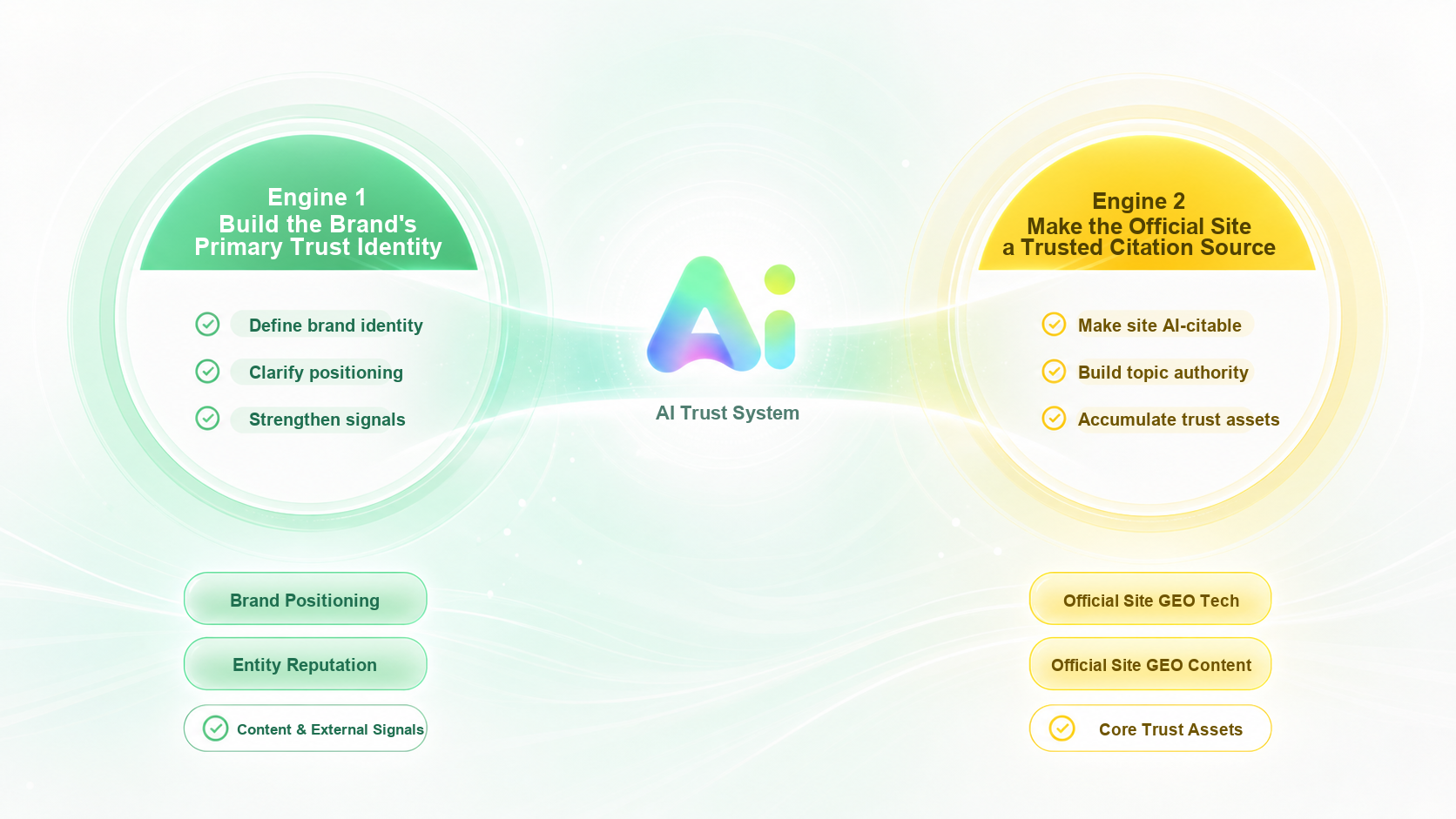
AI recommendations are driven by two trust engines: one identifies who you are, and the other determines whether your official sources can be safely cited. Brands that build both engines become more stable answer sources in AI systems.

Project SOP
This is the operational delivery model that turns GEO strategy into prompt assets, content/source execution, trust maintenance, and repeatable reporting.
Why UnderAI
Most GEO services stop at visibility. UnderAI focuses on trust, citation eligibility, and long-term answer-source status.
Cross-industry GEO experience
UnderAI has accumulated hands-on GEO experience across global SaaS, ecommerce, travel, EV, and technical product scenarios. We use these industry cases to identify recurring AI trust gaps and turn them into practical optimization paths.
Complex features, comparisons, and review pages cause AI to cite third-party lists instead of your product pages.
AI cannot confidently map your product entity, feature set, security claims, and pricing facts across owned and third-party sources.
Clarify product entities, implement SoftwareApplication schema, map comparison prompts, and identify the competitor sources AI is already using.
Ready to build AI trust?
FAQ
Answers to the questions teams ask before starting GEO: why AI does not mention your brand, which trust signals need repair, how results can be retested, and what your team should prepare first.
SEO mainly improves rankings, clicks, and organic traffic in search results. GEO focuses on whether AI answers from systems like ChatGPT, Perplexity, and Google AI Overview can understand, cite, and recommend your brand. UnderAI keeps SEO foundations, but extends the work into entity trust, answer structure, third-party sources, and retestable prompts.
More customers ask AI which company fits their need, whether a brand is credible, or what alternatives they should consider. If AI cannot recognize your brand, or only cites competitors and scattered information, you lose a recommendation moment before the customer reaches your website.
We build prompt tests around your brand, category, use cases, competitors, and high-intent questions. Then we check whether AI mentions you, how it describes you, which sources it cites, and what trust signals are missing compared with competitors.
The core work includes AI visibility diagnosis, trusted prompt libraries, website GEO content structure, FAQ and answer-page design, brand entity and proof mapping, high-citation source strategy, retesting, monitoring, and staged reporting.
The website cannot only act like a brand brochure. It needs answer-ready pages that clearly explain who you are, who you serve, what problems you solve, how you differ from alternatives, what proof you have, and which questions customers often ask.